 ultimate-guide
Modern Golf Technology for Amateurs: A 2026 Guide
Table of Contents
- Why Modern Golf Technology Matters for Your Game
- Launch Monitors and Swing Analysis: Measuring What Matters
- Benefits of Custom Golf Club Fitting
- How to Use a Launch Monitor for Practice
- Best Golf GPS Watches 2026
- Electric Trolleys and Wearable Technology: Beyond the Swing
- Building Your Budget-Friendly Tech Stack
Last Updated: September 25, 2026
Why Modern Golf Technology Matters for Your Game
Modern golf technology for amateurs has transformed how players approach improvement by replacing guesswork with measurable feedback on swing mechanics, ball flight, and performance gaps.
Launch monitors that once cost thousands now start at under £200, delivering professional-grade metrics. GPS watches and electric trolleys have made data-driven golf accessible to amateurs.
The best amateurs use modern golf technology to identify weaknesses, track progress objectively, and make data-driven equipment decisions. Golfers combining the right technology with structured practice see measurable handicap improvement within weeks.
The challenge is identifying which tools move the needle and which are expensive distractions.
Launch Monitors and Swing Analysis: Measuring What Matters
A launch monitor measures swing characteristics and ball flight in real time: clubhead speed, ball speed, smash factor, carry distance, and launch angle, revealing strike efficiency and actual distances.
Launch monitors expose distance gaps with precision. A golfer convinced they hit a 7-iron 160 yards might actually hit 145 yards, a gap that fundamentally changes course management and club selection.
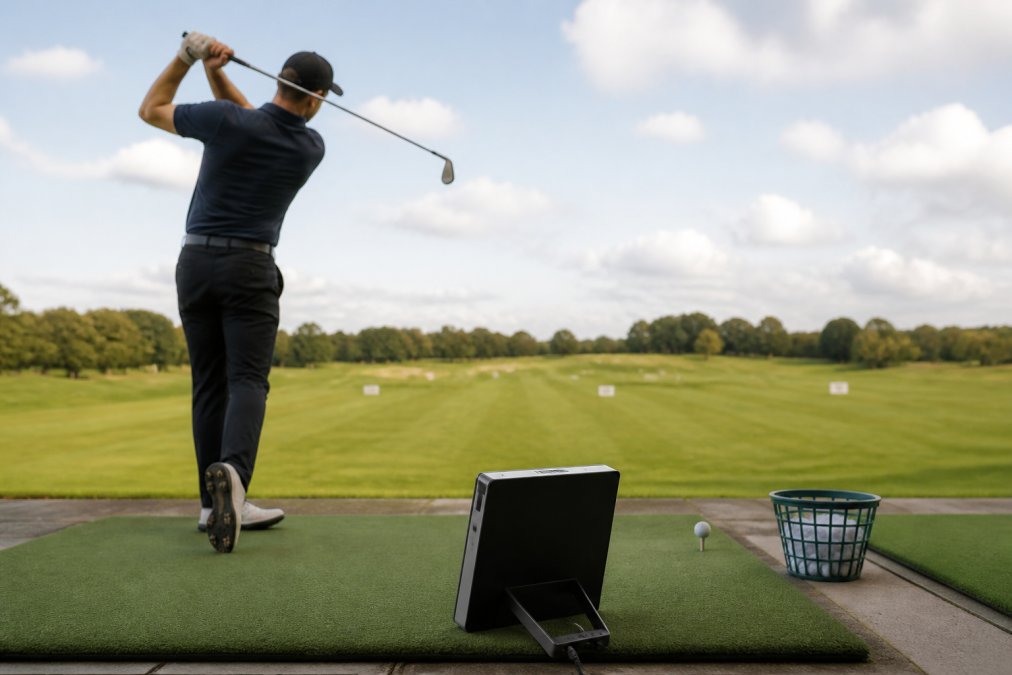
The Shot Scope LM1 (£199) uses Doppler radar to deliver five essential metrics: club speed, ball speed, smash factor, carry distance, and total distance. Setup takes minutes; place it 1.5 metres behind the ball, indoors or outdoors.

Real-time feedback is the key advantage. Smash factor (ball speed divided by club speed) reveals strike quality instantly. When it drops, you know your strike has degraded and can correct it immediately.
Speed training mode lets you measure swing speed and track gains over weeks.
Benefits of Custom Golf Club Fitting
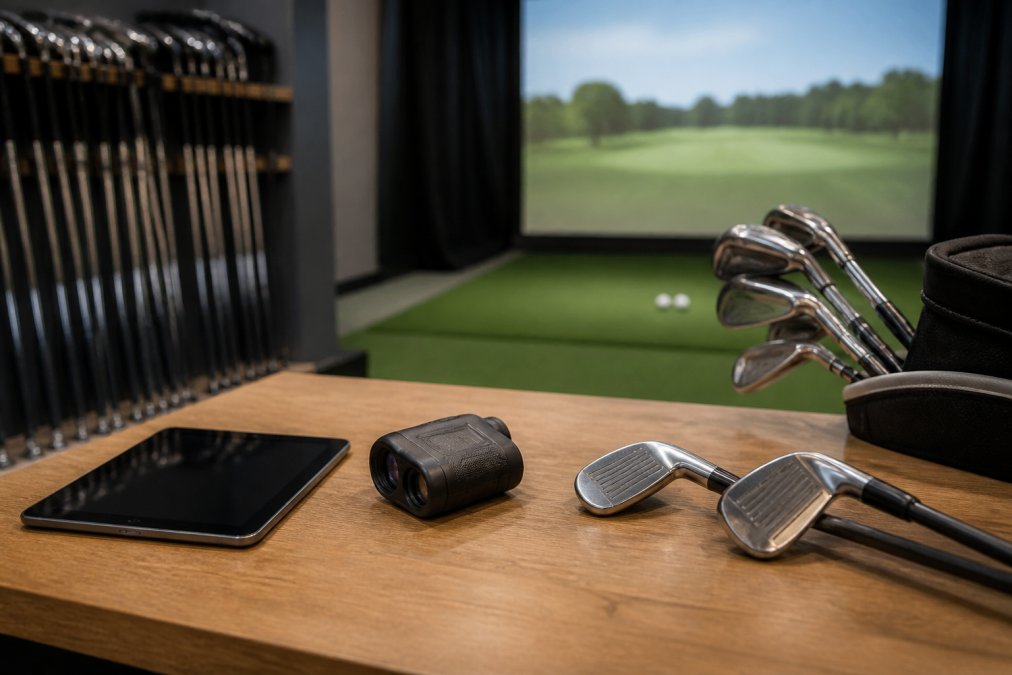
Custom fitting addresses a fundamental problem: off-the-rack clubs are built to average specifications, not your unique swing. This gap costs distance, consistency, and confidence.
A proper fitting measures swing characteristics and matches shaft flex, clubhead design, lie angle, and grip size to amplify your strengths, resulting in more consistent centre-face contact and lower scores.
Trackman 4 captures ball flight, spin rate, launch angle, and consistency, guiding equipment selection based on your actual swing characteristics rather than guesswork.
A golfer with a steep angle of attack and high spin rate might see balloons and distance loss with standard clubs. Custom fitting identifies this and recommends equipment that reduces spin and flattens trajectory.
Custom fitting prevents expensive mistakes by confirming equipment suitability before purchase.
How to Use a Launch Monitor for Practice
Launch monitors transform practice into structured improvement only with a methodical framework. The best amateurs isolate variables, track trends, and adjust swing or equipment based on measurable data.
Establishing Your Baseline
Establish a baseline by hitting 10 shots with each club under consistent conditions, recording carry distance, total distance, smash factor, launch angle, and spin rate. Compare every session against this baseline over 4-8 weeks to track progress.
Smash factor (ball speed divided by clubhead speed) reveals strike quality. A 7-iron at 1.38 indicates a solid strike; 1.32 suggests toe or heel contact. Real-time drops signal degraded strikes before distance data.
Structured Drill Progressions
Design drills targeting specific weaknesses. If 6-iron smash factor ranges from 1.35 to 1.42, hit 20 shots aiming for 1.38-1.40, tracking success rate. Repeat twice weekly for two weeks.
For distance consistency, calculate your average distance (mean of last 10 shots), then hit 15 shots aiming to stay within 5 yards of that average. Tighten to 3 yards as you improve. This directly improves on-course reliability.
Gap Analysis and Equipment Decisions
Launch monitors reveal overlapping club distances. If your 5-iron and 6-iron both carry 155 yards, adjust swing mechanics or equipment to create separation.
Gap analysis reveals whether you need a hybrid or additional wedge. A 20-yard gap between a 7-iron (145 yards) and pitching wedge (125 yards) might justify a hybrid at 160 yards.
Speed Training for Distance Gains
Shot Scope LM1 Golf Launch Monitor →
For distance gains, measure baseline clubhead speed with driver, 5-wood, and 6-iron. Dedicate two weekly sessions to speed work: swinging with intent, smooth acceleration, and lighter clubs or speed sticks.
Measure speed weekly.
Tracking Progress Over Time
Track metrics longitudinally in a spreadsheet: date, club, carry distance, smash factor, launch angle. Over 8-12 weeks, incremental gains (7-iron: 145→152 yards; driver smash factor: 1.48→1.51) compound into lower scores.
Retest baseline every 4 weeks. Stagnating metrics signal the need for drill adjustment or coaching; improving metrics confirm your practice is effective.
Best Golf GPS Watches 2026
GPS watches provide real-time course management: distances to front, centre, and back of green, green view (showing shape and hazards), and handicap tracking integration.
Modern GPS watches are accurate, reliable, and subscription-free.
Evaluate GPS watches on accuracy (within 1-2 metres), course coverage, battery life for 18+ holes, and a bright, responsive display.
Integration with launch monitors or scoring apps creates a data ecosystem linking swing metrics to course management, revealing patterns between yardages and results.
Electric Trolleys and Wearable Technology: Beyond the Swing
Electric trolleys and wearables extend technology value beyond swing metrics by addressing physical preservation and injury prevention.
Electric Trolleys and Physical Consistency
Electric trolleys preserve physical resources and swing consistency. Walking 7 km while pushing 15 kg depletes energy by the 15th hole, degrading tempo, balance, and strike quality. Electric trolleys eliminate this fatigue variable.
The Motocaddy ME offers remote operation from 100+ metres, dual manual/remote handles, 28V consistent power, and straightforward CLICK 'N' CONNECT charging.

The Powakaddy CT8 integrates GPS with a 7.6cm touchscreen (course info, distances, scoring, auto advance, green view, hazards, stroke indexes) and folds 35% smaller for practical transport.
For amateurs tracking their own data, an electric trolley creates a stable platform. Your launch monitor, GPS watch, and scoring app all benefit from the reduced physical exertion. You're gathering cleaner data because you're not fatigued, and your swing mechanics remain more consistent across 18 holes.
Wearable Technology for Injury Prevention and Biomechanical Safety
Integrating Trolleys, Wearables, and Injury Prevention
These technologies work together. You're gathering swing data with a launch monitor, managing the course with GPS information, preserving energy with an electric trolley, and monitoring biomechanical safety with wearables and warm-up apps. The result is more focused practice, more consistent play over 18 holes, and reduced injury risk, which is the foundation for sustained improvement.
For amateurs serious about longevity in the game, this integrated approach matters more than any single gadget. A golfer who prevents injury through biomechanical awareness and proper warm-up will play consistently for decades. One who ignores these factors will face recurring pain and forced breaks from the game. Modern golf technology increasingly supports both performance and preservation.
Building Your Budget-Friendly Tech Stack
You don't need to spend thousands to benefit from modern golf technology for amateurs. A practical stack can be assembled for under £500, and it delivers real value.
Start with a launch monitor. The Shot Scope LM1 at £199 covers the essential metrics. You'll understand your distances, smash factor, and consistency. Use it for structured practice sessions. Over a month of regular use, you'll identify patterns and weaknesses.
Add a basic GPS watch or rangefinder. Many golfers find a simple rangefinder sufficient for course management. It gives you accurate distances without the complexity of a full GPS system. Budget £100-150.
If you play regularly, consider a used electric trolley or a budget-friendly model. The Motocaddy ME Remote at £949 is a significant investment, but it's a one-time purchase that lasts years. If that's beyond your budget, a standard push trolley costs far less and still removes the physical burden of walking.
The key is prioritisation. If you're serious about improving, invest in launch monitor data first. That information guides every other decision. Course management tools come second. Premium trolleys are a luxury that improves comfort but not directly your scores.
Many golfers start with a launch monitor and a rangefinder, then add equipment over time. That approach spreads costs and lets you understand whether the technology is actually changing your game before committing more money.
| Technology | Entry Price | Primary Benefit |
|---|---|---|
| Launch Monitor | £199+ | Swing metrics and distance data |
| GPS Watch | £150+ | Course management and distances |
| Electric Trolley | £949+ | Reduced physical effort |
| Rangefinder | £100+ | Quick distance measurements |
Frequently Asked Questions
How can launch monitors like Trackman 4 help amateur golfers improve their scores?
Launch monitors capture precise data on club speed, ball speed, launch angle, and spin rate during every shot. This real-time feedback reveals inconsistencies in your swing and shows exactly how far each club travels. Amateurs use this data to identify which clubs perform best in their bag, spot technical faults affecting distance, and track progress over time. Understanding your true distances eliminates guesswork on the course and helps you make better club selections, directly lowering your scores.
Are golf GPS watches worth the investment for high handicappers?
Yes, GPS watches deliver measurable value for all skill levels. They provide accurate yardages to greens, hazards, and layup positions—removing the guesswork that costs high handicappers strokes. Many modern GPS watches include slope adjustment, which factors in elevation changes for more precise club selection. For amateurs focused on course management and consistent play, the cost (typically £150-£400) pays for itself through improved decision-making and reduced penalty shots over a season.
What is the difference between using a launch monitor at home versus on the course?
Home practice with a launch monitor lets you focus on swing mechanics without pressure, capturing hundreds of data points to identify patterns. On-course use provides real-world conditions and shot-tracking data that shows how your swing performs under pressure and in varied lies. Most amateurs benefit from combining both: use home practice to refine technique and build consistency, then validate improvements during rounds. This two-phase approach accelerates improvement faster than either method alone.
How does custom club fitting with Trackman 4 differ from standard fitting?
Standard fitting relies on visual assessment and general club specifications. Trackman 4 fitting captures your unique swing DNA—measuring launch angle, spin rate, clubhead speed, and ball flight for every club. This data reveals which shaft flex, head design, and loft angles suit your individual swing, not just your handicap. Amateurs fitted with Trackman 4 typically see improved distance consistency, tighter shot dispersion, and confidence in their equipment—changes that directly translate to lower scores on the course.