 ultimate-guide
How to Get Fitted for Golf Clubs: A 2026 Guide
Table of Contents
- What Is Custom Golf Club Fitting?
- Benefits of Custom Golf Club Fitting
- The Golf Club Fitting Process Explained
- How Long Does a Golf Club Fitting Take?
- Golf Club Fitting Cost in the UK
- What to Expect During Your Fitting Session
- Fitting for Different Skill Levels
- Post-Fitting Maintenance and Adjustments
- Frequently Asked Questions
Last Updated: September 18, 2026
What Is Custom Golf Club Fitting?
Custom golf club fitting tailors golf equipment to your individual swing characteristics, physical attributes, and playing style, matching your swing speed, angle of attack, ball flight patterns, and body dimensions to optimise performance.
A PGA Professional uses data-driven analysis to determine specifications including shaft flex, loft angles, lie angles, grip size, clubhead geometry, and club length, matching your equipment to how you actually swing.
At Major Golf Direct, we use advanced Trackman 4 launch monitor technology in our private fitting studios to capture the precise data needed for accurate recommendations. This technology measures swing speed, ball speed, launch angle, spin rate, smash factor, and carry distance, giving us a complete picture of your swing DNA. The result is equipment that feels right and performs consistently.
Benefits of Custom Golf Club Fitting
The primary benefit of being fitted for golf clubs is improved consistency and distance. When your equipment matches your swing, you hit more fairways, hold more greens, and score better.
Confidence is a measurable benefit: knowing your clubs are optimised for your swing helps you approach each shot with greater certainty and better decision-making.
Custom fitting prevents costly mistakes by eliminating guesswork. You understand exactly why each specification was chosen and how it benefits your game.
Fitting provides a foundation for improvement at all skill levels: beginners get forgiving clubs that promote proper mechanics, intermediate players get equipment that rewards good strikes, and advanced players get clubs that provide performance feedback.
The Golf Club Fitting Process Explained
Static Measurements and Assessment
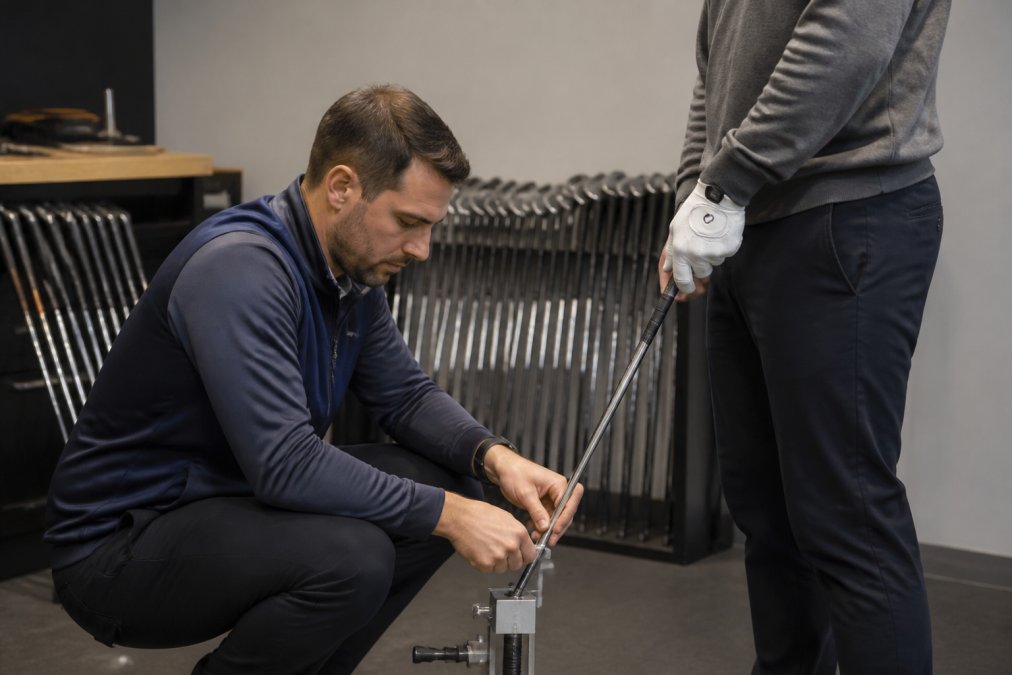
The fitting process begins with static measurements: height, arm length, hand size, and posture. These determine grip size, club length, and lie angle, foundational specifications that affect how the club interacts with the ground at impact.
Static assessment also includes discussion of your playing history, goals, and physical limitations, which affect shaft flex, loft angles, and club adjustments.
Dynamic Fitting with Launch Monitor Technology
The dynamic phase uses a launch monitor to capture detailed performance data: ball speed, launch angle, spin rate, smash factor, angle of attack, and carry distance.
You'll hit multiple shots with different club options. This data shows patterns in your ball flight, consistency, and performance, allowing the professional to identify which specifications optimise your results.
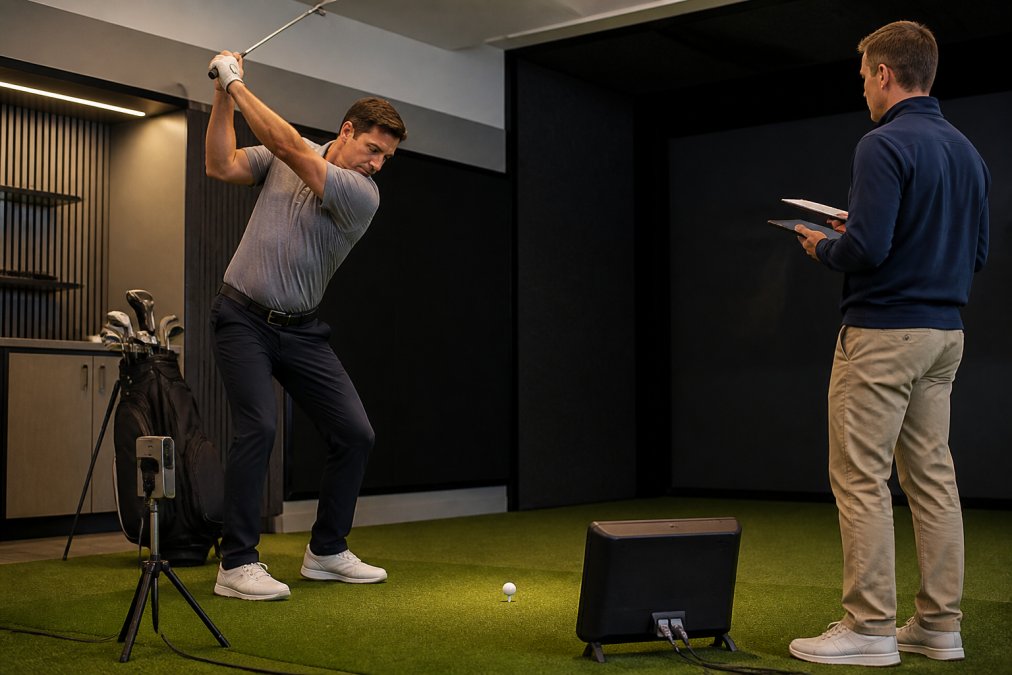
Consistent data collection during these sessions often reveals that the same metrics used to optimize your iron shafts can be replicated at home with a dedicated golf simulator setup to maintain your swing mechanics throughout the off-season.
Dynamic fitting reveals your actual swing path, impact consistency, and how different club specifications affect ball flight, showing how loft, shaft flex, and other factors influence your results.
The professional tests multiple shaft weights, flexes, loft angles, and clubhead geometries to identify the combination that produces the best results, data-driven decisions rather than assumptions.
How Long Does a Golf Club Fitting Take?
A complete golf club fitting session typically takes 60-90 minutes.
Golf Club Fitting Cost in the UK
Professional custom fitting costs vary by provider, location, and scope. Understanding your options helps you choose an approach that matches your budget.
Premium Full-Service Fitting
Comprehensive fitting sessions at dedicated golf studios use advanced launch monitor technology, include static and dynamic measurements, test multiple club options, and provide detailed written recommendations.
Retail Fitting Services
Many golf retailers offer basic fitting with club purchases or charge for standalone sessions. Retail fitting offers convenience but may be less controlled than dedicated studios, and recommendations may reflect retailer inventory.
Budget-Friendly and Lite Fitting Options
Budget-friendly alternatives include driving range consultations, mobile fitting services from independent PGA Professionals, and online fitting, though online services lack real-time feedback.
Cost-Benefit Analysis
Fitted clubs perform better from day one, accelerating improvement.
For regular players, premium fitting is a sound investment. For casual players, lite fitting or retail consultation offers a lower-cost entry point.
Ongoing Fitting Costs
Minor adjustments (lie angle bending, grip replacement, loft modifications) can be made. Schedule a check-in every 1-2 years to ensure your clubs remain optimised as your swing evolves.
What to Expect During Your Fitting Session
A professional fitting session is collaborative, data-focused, and designed to be informative rather than intimidating. Understanding what happens at each stage helps you prepare mentally and get the most value from the experience.
Before You Arrive
Wear comfortable golf clothes and shoes. Bring your current clubs for comparison. Mention any injuries or physical limitations when booking. Arrive 10-15 minutes early.
The Static Assessment Phase (10-15 minutes)
The professional takes measurements (height, arm length, hand size, and posture) and asks about your playing history, goals, and physical limitations. Honest input ensures better recommendations.
Mizuno JPX 925 Hot Metal Irons - Online →
Discuss any physical limitations, flexibility, back pain, mobility restrictions, as these affect club specifications and recommendations.
The Dynamic Testing Phase (45-60 minutes)
You'll move to the launch monitor area. The professional will explain the data captured: ball speed, launch angle, spin rate, smash factor, angle of attack, and carry distance.
You'll hit multiple shots with different club options. The launch monitor displays data in real time, showing how different clubs affect your results.
You'll hit 5-10 shots with each club option. Consistency is as important as peak performance; a club that produces consistently good results is more valuable than one with occasional excellent shots.
Interpreting the Data
During testing, you'll see several key metrics:
Ball Speed and Smash Factor: Ball speed is how fast the ball leaves the clubface; smash factor is ball speed divided by clubhead speed. A low smash factor (below 1.38 for drivers) suggests an off-centre hit or club-swing mismatch.
Launch Angle: For drivers, launch angle is a key metric. Too low loses distance; too high sacrifices roll.
Spin Rate: High spin can cause ballooning; low spin causes weak flight. The professional identifies your optimal spin rate.
Angle of Attack: For drivers, angle of attack is a key metric; for irons, downward is typical. Inconsistent angles may warrant setup or club adjustments.
Questions to Ask During the Session
Ask questions about shaft flex, lie angle, swing speed, smash factor, and trade-offs. The professional should answer clearly; if an explanation doesn't make sense, ask for clarification.
The Recommendation Phase (10-15 minutes)
You'll receive a summary of your swing characteristics and recommended specifications, including a written document with your swing data and explanations for each recommendation.
After the Session
You'll leave with detailed information about your swing and clear recommendations. Keep your fitting data as a reference point for future adjustments.
Fitting for Different Skill Levels
Beginner golfers benefit from fitting because proper specifications promote good swing mechanics and accelerate improvement by eliminating equipment-related inconsistency.
Intermediate golfers use fitting to identify the next level of performance; small improvements compound into lower scores.
Advanced golfers use fitting to optimise every detail, fine-tuning specifications that are already quite good.
Post-Fitting Maintenance and Adjustments
After your fitting session, maintain your clubs: clean clubheads after each round, check grip condition every few months, and inspect shafts for damage.
As your swing evolves, clubs may need adjustments: lie angles, grip sizes, and loft angles can be modified to match your improvements.
Schedule a re-fitting check-in every 1-2 years if you play regularly to ensure your clubs match your current swing characteristics.
Getting fitted for golf clubs is an investment in your game. The process is straightforward, the benefits are measurable, and the confidence you gain is immediate. At Major Golf Direct, our PGA Professional staff use Trackman 4 technology in private studios to analyse your swing and recommend equipment that genuinely improves your performance. Whether you're choosing the Mizuno JPX 925 Hot Metal Irons, the Wilson Staff Model XB Golf Irons, or the Wilson Golf Dynapwr Forged Steel Irons, a proper fitting ensures your clubs match your swing DNA.

Frequently Asked Questions
How much does it cost to get fitted for golf clubs?
Fitting costs vary depending on your needs and the clubs you choose. A professional fitting session itself may be complimentary or low-cost when you purchase fitted clubs. Custom specifications like shaft selection, grip size, and loft adjustments are typically reflected in the final club price. For example, quality custom-fit irons start from £799 to £949, with the fitting expertise included in the build process. Many retailers offer fitting services as part of their custom club purchase, making it an accessible option for serious golfers.
Is getting fitted for golf clubs worth it?
Yes, custom fitting delivers measurable improvements in consistency, distance, and accuracy. Data-driven fitting uses launch monitors to capture your swing speed, ball flight, spin rate, and clubhead speed, ensuring clubs match your unique swing DNA. Golfers report better dispersion patterns, more predictable carry distances, and increased confidence. Even if you've had previous fittings without improvement, modern Trackman 4 technology provides far more detailed performance data and optimization options than older methods.
How long does a typical golf club fitting session last?
A comprehensive fitting session typically takes 60 to 90 minutes. This includes initial assessment, static measurements (height, arm length, handicap review), and dynamic testing with a launch monitor to measure ball speed, swing path, angle of attack, and trajectory. The fitting professional will test multiple shaft options and loft configurations to find your optimal specifications. Time can extend slightly if you're exploring multiple club options or addressing physical limitations that require special consideration.
Do I need to be a low-handicap golfer to get custom fitted?
No. Custom fitting benefits golfers of all skill levels, from beginners to professionals. Beginner golfers actually gain significant advantage from fitting because it builds a solid foundation with clubs matched to their current swing characteristics. Intermediate and advanced golfers refine their equipment for performance optimization. PGA Professionals tailor the fitting experience to your level, explaining technical concepts clearly and focusing on the specifications that matter most to your game rather than overwhelming you with jargon.